
Bowling Green State University Athletics
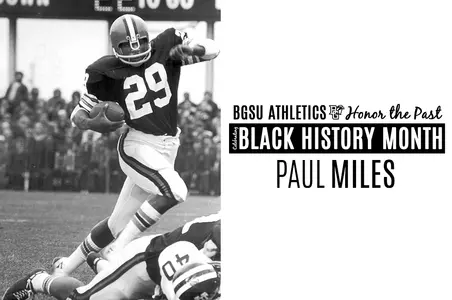
BG Athletics Celebrates Black History Month: Paul Miles
February 09, 2016 | Football, General, Hall of Fame
Throughout the month of February, BGSUFalcons.com will be highlighting some of those who have impacted the University, the community and the athletics department. From pioneers to more recent members of the department, Matt Markey will be providing the stories of our history. Today's feature story highlights Falcon football star Paul Miles. Fans can review all previous feature stories through our Black History Month landing page by CLICKING HERE.
The transition from the tiny western Ohio village of Paulding to the campus of BGSU was a major one for Paul Miles. The scale of everything changed.
"When I went to BG as a freshman in 1970, the biggest adjustment was the one I had to make coming from a small community to a college town and campus. It was all so different," he said.
Miles was one of very few blacks in his hometown, but he felt he had little in common with the other black athletes he encountered at BGSU at the time.
"That was another adjustment for me, because those other guys came from the inner city, from Cleveland and places like that, so their experiences were likely very different from mine," said Miles, who was No. 7 on the depth chart at running back when he joined the BGSU football team, but ended his Falcon career as the school's all-time leading rusher.
"I knew about racism, but I had more problems with other people who looked like me than I did with the other students at BG. I had white friends I grew up with, guys who would do anything for me. So when I sat with the other freshmen in the cafeteria at BG and not with all the black football players at another table, I got criticized and called 'Uncle Tom' by some of the black guys. A lot of them thought I was selling out."
Miles, a BG Hall of Famer who is the only Falcon football player to have his jersey number retired, said the situation improved over time.
"Eventually, a change took place with them. They found out who I was and what I was about," said Miles.
Miles said the numerous hot button social matters of the day – the assassination of Dr. Martin Luther King Jr., protests at the Olympics, the shootings at Kent State, and demonstrations against the Vietnam War – weighed on everyone. Joining Kappa Alpha Psi fraternity at BGSU, Miles said, helped him "fit in" and better deal with the issues.
"It was a difficult time, a very tense time, but I chose to take it out on the teams we played against," said Miles, who when he graduated from BGSU was only the third player in NCAA history to have three consecutive 1,000-yard rushing seasons.
Miles, who today is an award-winning blues singer-songwriter and musician, proudly lays claim to a unique identity.
"I am an indigenous black man. African-American is a label that other people came up with, but I don't find it offensive at all to be called black," he said. "I have Native Americans in my family, and I had a great grandmother from Holland, so if there is anything that can be said on this for me, it is that there is one humanity. We're all one family – and I don't understand all of the labels."
The transition from the tiny western Ohio village of Paulding to the campus of BGSU was a major one for Paul Miles. The scale of everything changed.
"When I went to BG as a freshman in 1970, the biggest adjustment was the one I had to make coming from a small community to a college town and campus. It was all so different," he said.
Miles was one of very few blacks in his hometown, but he felt he had little in common with the other black athletes he encountered at BGSU at the time.
"That was another adjustment for me, because those other guys came from the inner city, from Cleveland and places like that, so their experiences were likely very different from mine," said Miles, who was No. 7 on the depth chart at running back when he joined the BGSU football team, but ended his Falcon career as the school's all-time leading rusher.
"I knew about racism, but I had more problems with other people who looked like me than I did with the other students at BG. I had white friends I grew up with, guys who would do anything for me. So when I sat with the other freshmen in the cafeteria at BG and not with all the black football players at another table, I got criticized and called 'Uncle Tom' by some of the black guys. A lot of them thought I was selling out."
Miles, a BG Hall of Famer who is the only Falcon football player to have his jersey number retired, said the situation improved over time.
"Eventually, a change took place with them. They found out who I was and what I was about," said Miles.
Miles said the numerous hot button social matters of the day – the assassination of Dr. Martin Luther King Jr., protests at the Olympics, the shootings at Kent State, and demonstrations against the Vietnam War – weighed on everyone. Joining Kappa Alpha Psi fraternity at BGSU, Miles said, helped him "fit in" and better deal with the issues.
"It was a difficult time, a very tense time, but I chose to take it out on the teams we played against," said Miles, who when he graduated from BGSU was only the third player in NCAA history to have three consecutive 1,000-yard rushing seasons.
Miles, who today is an award-winning blues singer-songwriter and musician, proudly lays claim to a unique identity.
"I am an indigenous black man. African-American is a label that other people came up with, but I don't find it offensive at all to be called black," he said. "I have Native Americans in my family, and I had a great grandmother from Holland, so if there is anything that can be said on this for me, it is that there is one humanity. We're all one family – and I don't understand all of the labels."

Tuesday, October 13
Monday, October 12
Sunday, October 11
Sunday, October 11