
Bowling Green State University Athletics
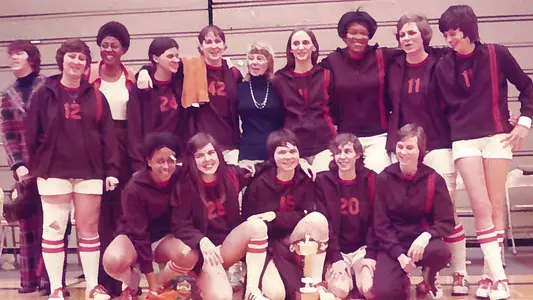
Heritage Series: Cathy Copeland-Mock
May 21, 2018 | General, Women's Basketball, Falcon Club, Heritage Sports
Throughout the months of April and May, BGSUFalcons.com will be highlighting some of the men and women who have impacted the University, the community and the athletics department. From pioneers to more recent members of the campus community, Matt Markey will be providing the stories of our history. In our sixth installment, women's basketball player Cathy Copeland-Mock talks about her time at BGSU and how it has impacted her career.
PREVIOUS HERITAGE SERIES STORIES
Bob Dwors
Noel Jablonski
Judy Jeanette
Carol Durentini
Doug Cahill
 When she arrived at Bowling Green as a freshman, anxious to try and make the roster for the BGSU women's team, the total number of high school basketball games Cathy Copeland had played was zero. While the young women from other parts of the state had participated in girls athletic programs at their high schools, the schools in Copeland's hometown of Columbus did not offer such opportunities.
She had played volleyball, softball and basketball at recreation centers, but lacked the coaching structure, formal training programs and multiple seasons of high school competition that the other would-be Falcons had used to hone their skills.
"When we started conditioning at Bowling Green, I thought I was going to die. I'd never done anything like that before," she said. "It was so grueling I wasn't sure I could do it. But my parents had always encouraged my brothers and I, and told us we could do anything, so I stuck it out."
She persevered, made the roster, and after spending the first half of the year on the "B" team, Copeland was a starter on the first unit for the latter half of her freshman season. A scoring and rebounding force, she credits her coach, Sue Hager, with being patient as Copeland's game improved.
"Coach Hager was so gracious to work with me, and my teammates were also very good about pushing me and encouraging me," she said. "I wasn't used to the rigor, but coach Hager kept pushing me to be more committed in conditioning, and keep working on my game, and my teammates -- they were great supporters as I adjusted to the demands of playing at that level."
It also helped that Copeland, now Cathy Copeland-Mock, was a rare six-foot-tall player in the days before BG women's program was part of the Mid-American Conference. "There were not many six-footers at the MAC level at the time," she said.
Copeland helped the Falcon women's team to a very successful run during her time on campus, with BG going 38-13 in her final three years. Copeland graduated in 1976 with a degree in physical education and a minor in business education, and credited coach Hager with allowing her to have a well-rounded college experience.
"The early '70s was a time when we were coming out of the civil rights movement and she knew that I was not just a basketball player," Copeland said. "She knew that I was involved with the Black Student Union and in starting a sorority, so she allowed for me to be active in social movements. She allowed me to be me and be more than a basketball player, and for that I am truly grateful."
Following graduation, Copeland taught and coached on the high school level in Cincinnati before moving to Boston to attend graduate school, where she earned a Master's degree in public administration.
She then returned to her native Columbus, worked as a substitute teacher for a while, took a job as an administrator with the state of Ohio for about 10 years, owned a printing company for 12 years, sold real estate for two decades, and now works as the director of supplier diversity at Cardinal Health in Columbus.
"They say you get nine lives – well, I think I've used all of mine," Copeland joked.
In her current role, she seeks out and identifies opportunities for a diverse group of suppliers – women-owned, minority-owned and veteran-owned businesses – to connect them with Cardinal.
"Everyone knows the value of small business and how they are the engine that drives the community, so this is really a way to improve the economic impact in our community," she said.
Copeland-Mock was recruited by Cardinal Health while she was serving as presidentof the South Central Ohio Minority Supplier Development Council (now the Ohio Minority Supplier Development Council).
"I never saw myself as the corporate type," she said. "I always looked at the corporate world as being out of my comfort zone, but I've been here 10 years now and gotten comfortable. The one constant in all of the stops along the way in my career has been that I'm really a people person. Everything I've done has been very heavily weighted towards helping people."
And she still looks at her role as being part of a team.
"Playing basketball at BG, I was listening to my coach, connecting with my teammates and working together towards a common goal. When I work with businesses in the community today, we do a lot of coaching, and those who listen, do well."
Since she played prior to Title IX being fully implemented, Copeland said she did not receive a varsity letter and her stats are not part of the official record of BGSU women's basketball. In the years since, when the Falcon media guide would come out she would needle her husband James over how her records were not printed in the book. Unbeknownst to her, James worked behind the scenes and one Christmas Copeland found a BGSU letter jacket, orange sleeves and all, under the tree.
"I still wear my jacket," she said. I'm proud of that."
ABOUT THE FALCON CLUB
The Falcon Club Scholarship and Success Fund was created to align the Athletic Department's fundraising priorities with the increasing need for scholarship support. Falcon Club membership gifts allow our programs to recruit and retain the best student-athletes as we compete for championships in the MAC and WCHA, while also preparing our current Falcons for success upon graduation. We hope you will consider helping us change lives by making an investment in the 400+ student-athletes that represent BGSU on the field, in the classroom and in the community. To make a gift please visit https://falconfunded.bgsu.edu/project/5311 or call 419-372-2401 to learn more.
PREVIOUS HERITAGE SERIES STORIES
Bob Dwors
Noel Jablonski
Judy Jeanette
Carol Durentini
Doug Cahill
When she arrived at Bowling Green as a freshman, anxious to try and make the roster for the BGSU women's team, the total number of high school basketball games Cathy Copeland had played was zero. While the young women from other parts of the state had participated in girls athletic programs at their high schools, the schools in Copeland's hometown of Columbus did not offer such opportunities.She had played volleyball, softball and basketball at recreation centers, but lacked the coaching structure, formal training programs and multiple seasons of high school competition that the other would-be Falcons had used to hone their skills.
"When we started conditioning at Bowling Green, I thought I was going to die. I'd never done anything like that before," she said. "It was so grueling I wasn't sure I could do it. But my parents had always encouraged my brothers and I, and told us we could do anything, so I stuck it out."
She persevered, made the roster, and after spending the first half of the year on the "B" team, Copeland was a starter on the first unit for the latter half of her freshman season. A scoring and rebounding force, she credits her coach, Sue Hager, with being patient as Copeland's game improved.
"Coach Hager was so gracious to work with me, and my teammates were also very good about pushing me and encouraging me," she said. "I wasn't used to the rigor, but coach Hager kept pushing me to be more committed in conditioning, and keep working on my game, and my teammates -- they were great supporters as I adjusted to the demands of playing at that level."
It also helped that Copeland, now Cathy Copeland-Mock, was a rare six-foot-tall player in the days before BG women's program was part of the Mid-American Conference. "There were not many six-footers at the MAC level at the time," she said.
Copeland helped the Falcon women's team to a very successful run during her time on campus, with BG going 38-13 in her final three years. Copeland graduated in 1976 with a degree in physical education and a minor in business education, and credited coach Hager with allowing her to have a well-rounded college experience.
"The early '70s was a time when we were coming out of the civil rights movement and she knew that I was not just a basketball player," Copeland said. "She knew that I was involved with the Black Student Union and in starting a sorority, so she allowed for me to be active in social movements. She allowed me to be me and be more than a basketball player, and for that I am truly grateful."
Following graduation, Copeland taught and coached on the high school level in Cincinnati before moving to Boston to attend graduate school, where she earned a Master's degree in public administration.
She then returned to her native Columbus, worked as a substitute teacher for a while, took a job as an administrator with the state of Ohio for about 10 years, owned a printing company for 12 years, sold real estate for two decades, and now works as the director of supplier diversity at Cardinal Health in Columbus.
"They say you get nine lives – well, I think I've used all of mine," Copeland joked.
In her current role, she seeks out and identifies opportunities for a diverse group of suppliers – women-owned, minority-owned and veteran-owned businesses – to connect them with Cardinal.
"Everyone knows the value of small business and how they are the engine that drives the community, so this is really a way to improve the economic impact in our community," she said.
Copeland-Mock was recruited by Cardinal Health while she was serving as presidentof the South Central Ohio Minority Supplier Development Council (now the Ohio Minority Supplier Development Council).
"I never saw myself as the corporate type," she said. "I always looked at the corporate world as being out of my comfort zone, but I've been here 10 years now and gotten comfortable. The one constant in all of the stops along the way in my career has been that I'm really a people person. Everything I've done has been very heavily weighted towards helping people."
And she still looks at her role as being part of a team.
"Playing basketball at BG, I was listening to my coach, connecting with my teammates and working together towards a common goal. When I work with businesses in the community today, we do a lot of coaching, and those who listen, do well."
Since she played prior to Title IX being fully implemented, Copeland said she did not receive a varsity letter and her stats are not part of the official record of BGSU women's basketball. In the years since, when the Falcon media guide would come out she would needle her husband James over how her records were not printed in the book. Unbeknownst to her, James worked behind the scenes and one Christmas Copeland found a BGSU letter jacket, orange sleeves and all, under the tree.
"I still wear my jacket," she said. I'm proud of that."
ABOUT THE FALCON CLUB
The Falcon Club Scholarship and Success Fund was created to align the Athletic Department's fundraising priorities with the increasing need for scholarship support. Falcon Club membership gifts allow our programs to recruit and retain the best student-athletes as we compete for championships in the MAC and WCHA, while also preparing our current Falcons for success upon graduation. We hope you will consider helping us change lives by making an investment in the 400+ student-athletes that represent BGSU on the field, in the classroom and in the community. To make a gift please visit https://falconfunded.bgsu.edu/project/5311 or call 419-372-2401 to learn more.
BG Baseball Cinematic Recap at Ohio State | 4.7
Friday, April 10
2026 BGSU Student-Athlete Networking Social (Stroh Center)
Wednesday, April 08
BG Volleyball vs Wright State
Sunday, April 05
Alex Laird Breaks Stolen Base Record #Shorts
Saturday, April 04