





Bowling Green State University Athletics
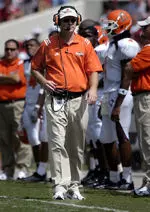
Gregg Brandon Press Conference
October 26, 2004 | Football
Oct. 26, 2004
BOWLING GREEN, Ohio - Bowling Green State University football coach Gregg Brandon met with members of the media at the Falcons' weekly luncheon Tuesday (Oct. 26), and shared his thoughts on the team's win over Ohio, the upcoming game against Eastern Michigan and a myriad of other subjects...
Q: BGSU had only one penalty in the win at Ohio. Was something done specifically to address that?
A: Well, we fixed the false starts, I think. It went away for at least a game. That was a mechanics problem with Omar Jacobs and Scott Mruczkowski. It was a coaching thing that we worked through as far as our no-huddle things. I don't remember a false start last year and then we get three in one game at Central Michigan. Well, what's different [from last year] is Omar. So, we worked through some things with how he enunciates at the line, how he says things, and the commands so we don't have those problems. So, let's hope they disappear.
Q: In terms of special teams, a couple of back to back problems, with the blocked punt and then the onside kick.
A: Well, the blocked punt was not Nate Fry or any other player's problem. It was a coaching error. They were able to scheme us and get us. The guy that came free we didn't account for, and he did a good job. I thought he [Chip Cox] was one of their best players. The onside was a perfect kick and they really executed that well. But we were caught with our pants down, so to speak. We were surprised. The thing that I liked about that was how our defense responded right after the blocked punt and the onside kick. Our defense went out and got a three and out. That was encouraging, and the next time they got the ball was the start of the second half. They kept it for eight minutes and didn't get a point. So, it was what ... 27 to 9 at that time? To me, if they had any chance of getting back in the game, that was it. And our defense again responded; we bend a little bit, but we're not breaking, and that's important to keep people out of the endzone.
Q: How did you grade the special teams, as a win or a loss?
A: A loss. I thought our kickoff cover was not as good as it had been. Our punt return needs to pick up. We were more effective early on with Chuck [Sharon]. We're not blocking well for him on that unit. We need to do a better job in that area, because he is a weapon. He has demonstrated that, and it's hard, when there are four guys around you, to make every one of them miss. So, we've got to do a better job with that team.
Q: On defense, the pass rush has been very noticeable over the past few weeks. What is causing that?
A: I think it's a combination of things. Our pass rush has always been effective and for some reason early on this year, it disappeared. Mitch Crossley had not played at that [same] level until the last couple of weeks for whatever reason, and now he's starting to gain some of that All-MAC performance level back. That's what he needs to do for us to be effective. Devon Parks is the same way. He's a very effective pass rusher as well, but the thing I liked about Saturday's game was the way our interior guys got a good push. Mike Thaler, Monty Cooley, Brad Williams, and Matt Leininger all did a good job when they got their shots in there, putting pressure on the quarterback ... particularly Leininger. Monty Cooley was a player of the game because he made a lot of tackles and got some hurries on the quarterback. So, those four guys really played well in the interior and Parks and Crossley are continuing to play better. The Northern Illinois loss was kind of a wake-up call for our defense that we have to play hard every week. We can't just show up and expect to beat people. We've challenged our defense every week that, 'here is the next opponent, let's go, let's play hard.' That's why we won 11 games last year, and unfortunately, the Northern Illinois game was a reminder that we can't just show up and beat people. It's hard to win Division I football games; I don't care if you're Oklahoma or Bowling Green, it's hard to win. That's why we won 11 games last year; because we were focused and we played hard every game. The thing that happened to us early, I think, was that we got a little complacent, and thought that we could go into DeKalb and beat NIU and we didn't have enough in the fourth quarter to get that done. So, we challenged our players, particularly the defensive line, to step it up and wreak havoc like that we did last year at times. And they've done that and that's a big reason, along with the productivity of our offense, of why we've won four in a row.
Q: Obviously, an effective pass rush makes the defense better, but can you expound on that?
A: Well, I think that any time you can get a quarterback looking around, other than at what he's supposed to be looking at, you're going to create some problems for an offense. If you can flush him out of the pocket, if you can put some heat on him that way and make him hurry and throw it or sack him, that fuels the defense. They get excited when they get a sack because it's a negative play. We talk about it on offense all the time -- we've only given up three sacks this year. And really, we haven't given them up, we've taken them. The one that happened against Ohio was all on Jason Washington, the backup quarterback. He had the chance to throw the ball away and he took the sack. It wasn't anything the defense did. The two on Omar, he was running out of there and didn't throw the ball away. None of the sacks have been on the offensive line, and we're protecting better than anybody in the conference right now, with only three sacks taken ... I don't look at them as we gave them up, we just flat took them. And that's on the quarterback. Our receivers have been getting open fast, and our protection has been great all season. How many games has Oklahoma played where they have not gotten a sack in the last two years? I'd like to do a little research on that. I know one -- Bowling Green.
Q. Mike Crumpler started ahead of Keon Newson at safety. Why?
A: Well, Keon didn't practice much during the week, and he wasn't as ready to go in the game plan as Crumpler was.
Q: Do you expect to go back to Keon on Saturday?
A: Absolutely.
Q: Is the lack of offensive rushing production a concern?
A: It's only a concern if we're not winning. The way I look at it is if I'm Ohio and I possess the ball, running it for nine minutes and I get no points, and I'm Bowling Green and I score 41 points throwing for 400 yards ... I want to score points. If I can run it to score points, I'll run it. If I can throw it to score points, I'll throw it. Right now we're throwing it. I don't think it's alarming that our rushing points have fallen off. We have a goal or a statistic that we measure, and it's yards per touchdown. For every 100 yards, we better be getting seven points. We've gotten that goal six out of seven times this year. So, if we have 500 yards of offense, we better score 35 points. If we have 500 yards of offense and three touchdowns, that's not good enough. You can have tons of yards, but that's not what's on the scoreboard at the end.
Q: You have talked (earlier in the season) about the fact that you simplified the offense. Have you taken away any rushing options from Omar that you used with Josh (Harris)?
A: We haven't taken any of that out, we're just not using it as much. Omar has emerged as a very effective passer, and that is what we want to do with him. We want to throw the football. Our receivers have matured now to the point where they can get open against just about anybody. Our protection is such that when we give Omar time we can do some things. Those runs are still in the package, but we're just not calling them. We're calling the throws, and I think that's more because of the emergence of Omar, and the improvement at the receiver position -- particularly Steve Sanders. We knew Chuck Sharon and Cole Magner were good and people are trying to take them away a little bit. Steve Sanders has emerged down the middle of the field. Omar is able to throw it accurately, and that is basically what is going on.
Q: Can you give us a scouting report on Eastern Michigan?
A: Eastern is vastly improved, I think, particularly offensively. Their quarterback (Matt Bohnet) is being efficient, he's taking care of the football. (Head coach) Jeff Genyk has done a good job of getting those kids to believe they can win. They've won two MAC West road games, which is tough. Eric Deslauriers is a very good receiver, he's catching a lot of balls. I think he's in the top three in the conference. I like him. The running back, Anthony Sherrell, had a good game against us last year. He's been hurt, but I think he's going to play against us. We need to tackle that guy, because we didn't tackle him last year. Their offensive line is protecting fairly well, they haven't given up that many sacks. They're doing what they need to do to possess the ball and score some points. I think they're in the top four or five in the conference in just about every category. So, they've improved as an offensive football team.
Q: How about on defense?
A: Defensively, they are a little bit undersized, but they're a quick defense. I like the way their linebackers run around. Kevin Harrison is a good player. They just don't have the girth up front, and I'm sure that they're recruiting to try and get that. That's one thing you notice when you watch them on tape is that they're a little bit undersized, but they do play with a high level of intensity.
Q: How different is EMU now than they were a month ago?
A: Not much different. The difference is, they found a way in the fourth quarter to beat Western Michigan, and they found a way in the fourth quarter to Ball State. That's all it is, because the two games they lost to Idaho and Eastern Illinois, they didn't get it done in the fourth quarter. They could have won those games easily. I think that's more of a mindset that, 'hey ... let's win this game in the fourth quarter, it's here for the taking.' That's where I appreciate the job that Jeff Genyk is doing, in getting those kids to believe that if they're hanging around in the fourth quarter, they've got a chance. That's true for us; we don't just play games to get to the fourth quarter. But, I think when you're building a program, that is a good way to approach it ... let's take care of the ball, let's play good defense and not turn the ball over, and in the fourth quarter let's look up at the scoreboard and say 'we've got a chance to win.' That's what we did the first year here with Urban (Meyer). We said, 'all right, lets take care of the football, let's try to run the ball and possess it, keep our defense off the field, look up in the fourth quarter and go all right, are we a touchdown, a score out, can we win this thing?' And then go win it. That's what I think Jeff has done vs. Ball State and Western Michigan. Of course, Western Michigan gave (the ball) to them, they turned the ball over late. But, they still had to score a touchdown to win the game. So, I give them credit that way. I don't want them hanging around in the fourth quarter on Saturday, I guarantee you that.
Q: With the shared history you have with Jeff Genyk, how similar is their offense to yours?
A: It's very similar. In the running game, you'll see a lot of similarities and schemes. Not necessarily the way they play with a tight end quite a bit and two backs. The passing game is very much like we ran a couple years ago. The three-step game, get the ball out quick. I mean, they're doing a good job getting the ball out. He's not taking sacks, they're not throwing interceptions. I think there's a lot of similarities that way. We're probably more in the true spread than they are, but you can see that's what they like to do.
Q: Is the difference more of a personnel thing?
A: Yeah, and I think they're growing. When you put something new in, you've got to find out their problems. We've been in our system going on four years now; we know our problems. And when you're going through that for the first time, you don't necessarily know what your guys are capable of. When we came in here, we didn't know what Josh Harris or Andy Sahm were capable of. I didn't know what our offensive line could do, if we could hold up and have a passing game. We felt like the first thing we needed to do was establish a running game, because that gave us our best chance to possess the ball and help our defense out. And you see them doing that. I mean, they're second in the conference in rushing.