

.png&type=webp)



Bowling Green State University Athletics
BG Future Built on Past
August 06, 2001 | Football
Aug. 6, 2001
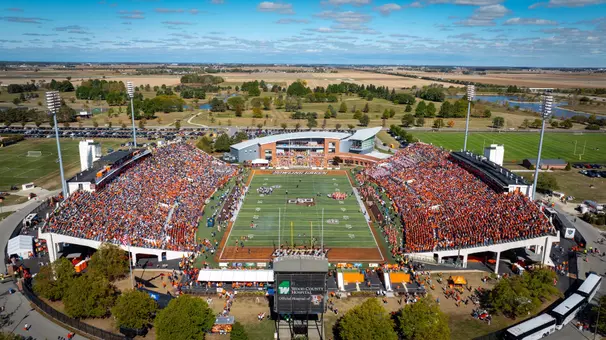
BOWLING GREEN - Urban Meyer stands in an empty stadium, but he is hardly alone. The spirit, the dignity, indeed the ghosts, of a proud past all stir around him. He wants to show proper respect for that heritage as he goes about trying to put the luster back in Bowling Green State University football.
The Falcons new head coach knows that 10 Mid-American Conference championships have been won here, and 14 All-Americans have played for the Falcons. And Meyer clearly wants to be here - a place where he feels that winning means something.
He sees Carlos Jackson slicing through the line, a crunching block from Brian Sherman, Paul Miles making a safety wish he had stayed home, and Dave Preston running over, around and through six defenders who had a shot at him and missed.
Meyer feels Vince Palko standing a running back on end, and Martin Bayless letting the quarterback know the perils of the safety blitz. He envisions Brian McClure sending a missile 50 yards down the field, and Mark Szlachcic defying gravity and physics to surround a pass and stay inbounds.
Meyer sees former coaches Don Nehlen, Denny Stolz and the guy they named the stadium after - Doyt L. Perry - pacing the sidelines. Beloved former equipment man Glenn Sharp fixes a chin strap and barks at a player for stepping on his warmup jacket. Longtime grounds chief Ken Schoeni brushes the turf with his hand, and wishes there had been more rain.
Those are the guys Urban Meyer answers to now. A decorated past and rich tradition matter to Meyer, who left one of the most storied programs in college football - Notre Dame - to become the 15th head coach in BGSU history.
"I don't believe I would have left the situation I was in at the University of Notre Dame for a school that didn't have high expectations," Meyer says. "One of the coaches in this conference told me that if he wins as many games as he loses and graduates some of his players, then everyone there is happy. That's not the kind of program - that's not the kind of attitude - I want to be a part of. I want to be part of a place where a so-so performance is not acceptable. That's the essence of college football. I know that, and our players are going to know that."
Bright baseball future Meyer was a standout in football and baseball in the early 1980s at St. John High School in Ashtabula, east of Cleveland. His school was always the smallest in its league, and constantly had something to prove.
"After a big win over Ashtabula High, the newspaper ran a photo of Urban with his arms raised, holding his helmet in the air and signifying victory," said Paul Kopko, Meyer's coach at St. John. "He had a tenacity about him, and he despised losing. He was always striving to be the best, and it was infectious with his teammates. You could see his leadership potential way back then. Urban had the ability to rally guys when things were going bad."
Meyer was a defensive back and running back at St. John, where Kopko said the intangibles a football coach craves made Meyer rise to the top.
"Urban was never the biggest or the fastest guy we had out on the football field, he was just the best," Kopko says, "because he wouldn't accept being anything less."
Meyer quarterbacked the baseball team from his shortstop position, and was good enough to be a 13th-round draft pick of the Atlanta Braves in 1982.
"He was a skinny kid as a sophomore, and came back as a real stud in his junior year," said Bill Schmidt, Meyer's baseball coach at St.John. "He was a terrific infielder and a great hitter, and the kind of player who took charge. Urban was an all-around athlete, but in baseball he really had a chance to go somewhere."
Injuries cut short Meyer's baseball career, and he moved on to the University of Cincinnati, where he played defensive back and earned a degree in psychology. He did his graduate work at Ohio State, solidifying his foundation in the Buckeye state that would one day help him land a Division I head coaching job at age 36. He has since turned 37, and is the second-youngest Division I head coach in the country.
"The fact he has risen so far so fast is not really a surprise to any of us who knew him growing up," said Don Cannell, the principal at St. John during Meyer's high school days.
"Urban wasn't just an outstanding athlete, he was a kid with real character. Being honest mattered to him, and I think his teammates, and now his players, take a great deal of motivation from that. There's nothing phony about him, and Urban's quick movement through the coaching ranks proves that good things happen to good guys."
Paying his dues Meyer was a graduate assistant under head coach Earle Bruce at Ohio State in the 1986 and '87 seasons, then coached for Bruce at Colorado State a few years later. Bruce, the brusque field general, had a hundred applicants for positions on his staff, but chose Meyer.
"The thing that always impressed me about Urban was that he had the enthusiasm of a very young man, but the knowledge and grasp of the game you would usually only see in much more experienced coaches," Br uce says. "He could put together in his head what the game of football was all about. There are a lot of football coaches, but not many who can do that."
Bruce said Meyer blossomed at Colorado State, where he coached the wide receivers for six seasons.
"He had a rapport with the players, and had their respect," Bruce says. "When someone called me about a job being open, he was the first one I recommended to them."
Meyer moved to Notre Dame in 1996 and coached one season under Lou Holtz before Bob Davie took over the Irish program. Meyer completed his fifth year at Notre Dame as he was assuming control at Bowling Green, where a sixth straight losing season had meant the end of the line for 10-year head coach Gary Blackney.
"Bowling Green is extremely fortunate to get him," Davie said. "You hate to lose good coaches, but that's part of this business. Urban Meyer is one of the best football coaches I've ever been around. I think he'll be a star in this profession."
Bruce said Meyer has landed in the ideal situation, since the Falcon faithful are longing for a return to the glory days when BG was a dominant force in the MAC.
"Urban knows the great history there, and the tradition of people like Doyt Perry, and his expectation level for himself and the program is very high," Bruce said. "He won't change his approach just because they have been struggling lately. He'll want his teams to be like the best teams they've had at Bowling Green over the years."
Tough job, right guy BG athletic director Paul Krebs was a committee of one when he set out to find a new coach for the Falcons following Blackney's resignation four games into last season. The pile of qualified appli- cants - coordinators at top pro- grams, battle-tested assistants, current and former head coaches - became an obstacle, but Meyer kept surfacing at the top of the stack.
"Part of it was just an instinctive feel, that he was the right person for the job," Krebs says. "There was also a combination of other factors - his involvement with successful programs, his experience with a program that was revived at Colorado State, and his experience in recruiting in Ohio - that told me Urban had as much of the total package as anyone."
Krebs didn't just need a coach. He needed someone who could chase away the pall that losing had created, someone who could reverse sagging support from alumni and boosters, and someone who could sell himself as he sold tickets to every club and community organization that would listen.
"It wasn't enough that he be a great football coach," Krebs says. "This is a very difficult job, but Urban has such an intensity and focus about him. I thought his upside was potentially brighter than anyone else's."
Meyer was out recruiting the same night he got the BG job, and made an early visit to Anderson Arena to seek out men's basketball coach Dan Dakich, who is close to Meyer's age and, like Meyer, has a family with young children.
"The first thing he wanted to know was if this was a good place for his family," Dakich said. "He wanted to know about the environment on campus, the city, and how to get the students interested in coming to the games, and if people here really cared about winning. He was concerned about all of the right things, and that impressed me."
Meyer admits he faces an ominous task. The team showed a propensity for fading late in games last year, the players seem to have grown accustomed to losing, and attendance has been poor.
"We have to change the way we do everything," he said. "And eventually we have to turn out a winner."
Don Nehlen knows the pressure Meyer operates under. Nehlen was a star quarterback for the Falcons and won a MAC championship playing for Doyt Perry in 1956. Nehlen coached the Falcons from 1968-76 and was let go despite going 53-35-4. He went on to a successful tenure at West Virginia and retired after last season, but has had little direct contact with Bowling Green since he was fired.
But Meyer has honored Nehlen by bringing him in to speak to the team, part of a concerted effort to rally the heroes of BG's glory days.
"I don't know Urban real well, but I really like the fact he's bringing back some of the former players and coaches and making them a part of this program again," Nehlen says. "That shows class, and a real deep-seated respect for the guys who won championships there. I looked at the schedule and it's murder, but if anyone can turn things around at Bowling Green and make them a winner again, my gut feeling is that he can do it."
Bruce, who was always under the gun in his days in Columbus, said he is confident Meyer will put the polish back on the program.
"Listen," Bruce says, "they got the right guy."